five-forces-of-ai-in-the-enterprise
Five Forces of AI in the Enterprise
In a very short amount of time since OpenAI announced their first public GPT, AI has already caused significant changes in work and business. New technological developments are being announced almost daily, and business responses make the news about as frequently. It is guaranteed that the future of work will be nothing like the work of today.
Organizations are increasing adoption not necessarily because of AI’s promised benefits, but because they must in the presence of AI’s expanding utility and adoption by competitors. Massive interest has fuelled significant investment by business and markets. Meanwhile, others deride that potential and current utility as overblown hype. Nonetheless, however anyone wants to look at it, the technology will not go backwards. We are already witness to the beginning of seismic changes in business, work, and society.
Technology sparked the revolution and continues to drive change, but it is now only one of several forces reciprocally impacting each other and collectively driving and influencing change.
Organizations hanging back while the dust settles will eventually come to the realization that the pace and number of changes are not abating, and that AI is not a single, individual trend. As specific forces become too important to ignore, such as new products or competitor capabilities powered by AI adoption, they must act even if it is just to keep up.
Some organizations recognize that these changes are generational and require proactive strategies that recognize that the business landscape and future of work will NOT be the same as that of today. The challenge for these organizations, however, is that strategic thinking implies the need for a structured way to model and understand AI-relevant forces. Real strategists must acknowledge the complex interplay of multiple forces but balance this with a manageable analysis and plan. Classic models, such as Porter’s Five Forces, SWOT, and PESTLE, have proven their usefulness over decades of application, but we believe that today’s unique challenges and opportunities presented by AI demand an AI-based model.
We introduce just such a model in this article: the Five Forces of AI. This model sets out a framework and method to analyze the internal and external environments of an organization when developing an AI adoption or transformation strategy and to assess its attractiveness.
Introducing the Five Forces of AI
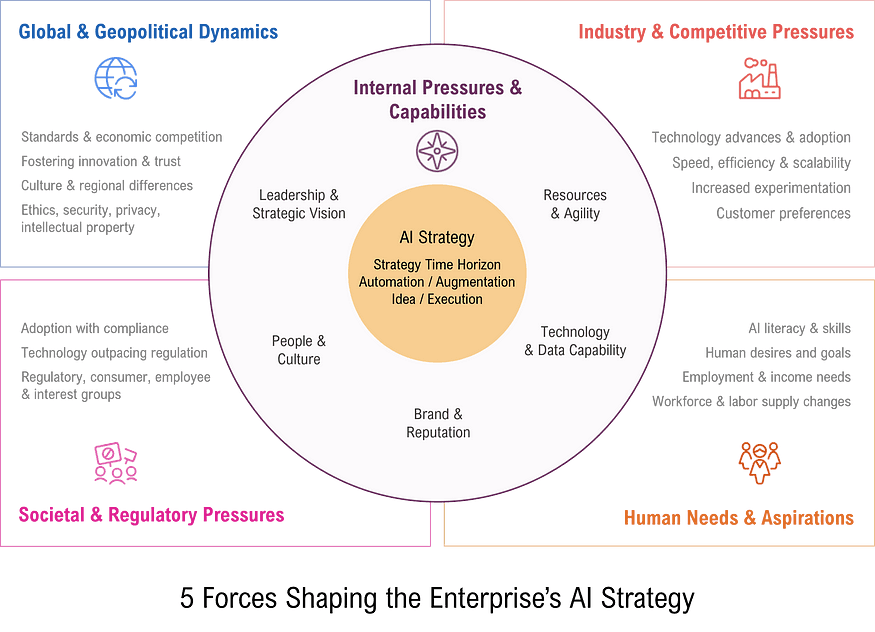
The model consists of one internal force and four external forces. The internal force is represented by the larger circle, and for AI strategy it helps the enterprise confront what it wants and what it can realistically achieve. Each outer block represents a major type of external force. The four external forces are broad, extending from the enterprise’s microenvironment (e.g. direct competition, industry trends, etc.) to the macroenvironment (e.g. international markets, foreign policy, etc.). We believe that, today, it is prudent for the AI strategist to scan so broadly because even remote factors can have immediate and direct impact on the enterprise’s local environment — certainly more so than when Porter published his Five Forces.
For example, in one month after technology and hardware constraints led to DeepSeek’s release of its language model that made mainstream news, sent share markets into a spin, and sparked a global AI “space race”, development has increased on smaller LLMs and SLMs, DeepSeek and similar models from competitors are downloadable from HuggingFace, and are in use by many solutions built on the current proliferation of agentic AI platforms. Another couple of months later, there is now the possibility that the US government will ban DeepSeek. No one can predict the future with certainty, but scanning more of the AI landscape can help strategists and planners make smarter choices.
AI Strategy at the Center
As for your organization, your AI strategy should be agile. Emphasize higher-level principles (e.g. who do we want to be? why do we do we what we do?) because details set in concrete are constantly at risk of fast obsolescence or disruption. The higher-level principles will help the organization avoid being too reactive to rapid changes in the environment.
For this reason, AI strategy should explicitly state its assumptions about its time horizon, build greater agility into its more detailed aspects, and be itself formulated and managed in an agile way.
The technical objectives of an AI strategy are likely to be characterizable as tending toward either automation or (human) augmentation (or both) in nature. In longer strategy time horizons, automation-first strategies are probably riskier than strategies that include human considerations. This assertion will be explained in a planned, future article.
Organizations that use AI to optimize what we term the Idea-Execution Dynamic will ultimately be more agile. The traditional advice has long been that “ideas are cheap; execution is expensive”. However, AI is lowering execution barriers. In our future article, we will make the case for how optimizing the Idea-Execution Dynamic for greater agility can create new opportunities.
The Five Forces of AI in Detail
1. Internal Pressures & Capabilities
The elements below are specific to the organization and emphasize internal mission, alignment, readiness, and capabilities.
Leadership and strategic vision. Strategic priorities, long-term goals for AI adoption or transformation, ability to rally the troops.
Resources and agility. Financial resources, structural agility, data and AI maturity.
People and culture. Organizational culture, openness, agile and change mindset, data and AI literacy, emotional aspects.
Technology and data capability. Technology infrastructure, digital readiness and maturity, process maturity, data assets and management, governance structures.
Brand and reputation. Corporate image and brand equity, ethical AI, trust and transparency, leadership in AI innovation, reputational risk management.
2. Global and Geopolitical Dynamics
Organizations should periodically survey the shifting landscape as nations and regions compete to achieve AI dominance, shape global standards, protect security interests.
Technological and economic leadership and competition. Global competition, policies, trade barriers directly impact the organization.
Strategic assets and intellectual property protection and security. Global competition includes fostering innovation and protecting assets developed.
Regional differences in culture, ethics, and workforce capabilities. Education, language, work ethic, individualistic vs. collectivist societies, all impact how AI develops and is adopted.
Laws, standards, ethics, privacy, and intellectual property. Challenges related to enacting laws and standards that protect interests, avoid stifling innovation and progress, at sufficiently relevant pace.
3. Societal and Regulatory Pressures
This force focuses on the tensions created by regulation and society.
Technology outpacing regulation. Regulation and standards lag behind technological advancement, creating uncertainty and risk.
Adoption with compliance. Gap between technology and regulation may influence the method, pace, scale, or sequence of adoption.
Regulatory, consumer, employee, and interest groups. Influence of stakeholders who advocate for specific outcomes require appropriate stakeholder management.
4. Industry and Competitive Pressures
The competitive and technological microenvironment of the organization with respect to AI is highly dynamic.
Technology advances and adoption. Pace of technological progress, competitive pace of adoption, products and expertise servicing the organization’s industry.
Speed, efficiency, and scalability. Industry and competition pressures influencing the organization’s own AI adoption priorities.
Increased experimentation. Taking advantage of opportunities offered by AI to increase experimentation. Optimizing the Idea-Execution flow in the value and revenue chains.
Customer preferences. Customers will be attracted to organizations that understand how to use the technology to better satisfy them without harming the relationship through ill-advised adoption.
5. Human Needs and Aspirations
Many thought leaders are increasingly sounding the alarm that humans will be largely displaced by AI in the workplace. However, this is an important force as long as organizations exist to profit from humans.
AI literacy and skills. The AI capabilities of the organization depend on the skills and competencies of the people architecting, facilitating, and driving change.
Human desires and goals. Encompasses both customers and employees’ values and desires.
Employment and income needs. Organizations may be able to take advantage of scaling and efficiency opportunities of AI and simultaneously provide meaningful, gainful employment to humans.
Workforce and labor supply changes. Changing Idea-Execution dynamics, increasing AI literacy, deficiencies in traditional HR recruitment models may impact organizational strategy.
While our experience in startups, scaleups, and enterprise agile and digital transformations has informed our development of this model, we fully expect this model to evolve. Nonetheless, we believe that this Five Forces of AI model is comprehensive and structured to greatly assist your organization’s AI strategy. You are invited to use the model in whatever way is useful to you. Your feedback is welcome and will be used to review and refine the model.